A carbon credit is a promise that one tonne of CO₂-equivalent emissions was avoided or removed somewhere in the world. The entire market — every voluntary buyer, every compliance scheme, every net-zero claim made by a listed company — rests on the trust that this promise is true. Strip that trust away and the credit is worth nothing. The carbon market does not have a pricing problem; it has a verification problem. the Client’s positioning as a regional leader in the carbon credit revolution is not about issuing more credits faster — it is about issuing credits that survive an auditor’s scrutiny five years after they were minted.
That requirement is what made the engineering brief interesting. the Client needed a platform where a kilowatt-hour reading from a digital power meter in a Malaysian building could be traced — with cryptographic proof — all the way to a tradeable carbon token sitting in a buyer’s wallet, with independent verifier sign-off in the middle. Our team designed a five-layer architecture that uses Hyperledger Fabric as the private trust anchor for raw meter data, a centralised management portal as the human workflow surface, and the Polygon public network as the tokenisation and trading rail after verification by Verra, Gold Standard, and other accredited bodies. The rest of this article walks through each layer, the reasoning behind the technology choices, and how the private-to-public handoff actually works in production.
- Raw meter data belongs on a permissioned chain, not a public chain — Hyperledger Fabric gives our team deterministic finality, zero gas cost per reading, channel-level privacy, and governance that regulators can actually inspect.
- The Polygon bridge exists for one job only: turning a verified credit into a transferable token whose provenance points back to the Hyperledger transaction hash, so the public market can audit the private record without seeing every meter reading.
- Verra and Gold Standard verification remains a human step on purpose — markets price credits according to who certified them, and accredited human sign-off is the source of that price premium.
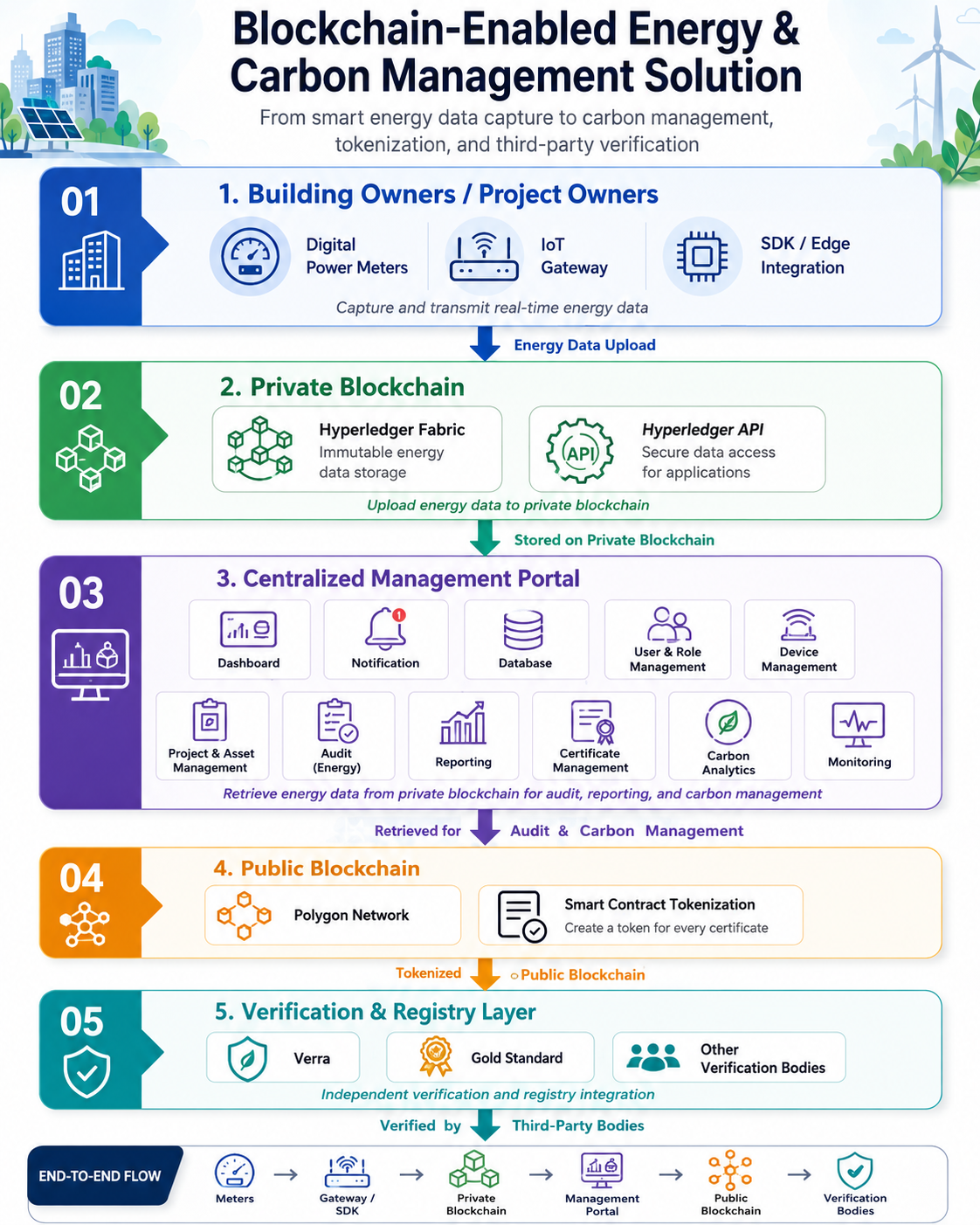
- The end-to-end flow our team designed runs from smart meter through Hyperledger Fabric, the management portal, the verifier workflow, and finally onto Polygon as a tokenised credit ready for the the Exchange platform.
- Hybrid private-plus-public chain architecture is now our default pattern for any real-world asset tokenisation project — carbon credits are simply the cleanest example.
Why Carbon Credits Need Blockchain at All
The voluntary carbon market has been criticised for years over three recurring failures: double-counting (the same tonne sold to two different buyers), retroactive data manipulation (project owners revising baseline numbers after the fact to inflate avoided emissions), and opaque MRV (no buyer can trace a credit back to the underlying measurement that justified it). None of these failures is technological in origin. They are organisational failures of record-keeping. But the only proven defence against them at scale is a tamper-evident ledger that records every measurement, every calculation, and every issuance event in a sequence no party can quietly rewrite.
This is where blockchain stops being a marketing word and becomes a load-bearing engineering choice. The chain is not there to "be innovative". It is there because every other architecture our team evaluated — centralised databases with audit logs, signed PDF reports, third-party escrow registries — ultimately depends on trusting whoever administers them. The chain removes the administrator from the trust equation. What goes in cannot be silently altered, and what is altered leaves a public trace.
That said, not every part of an MRV workflow benefits from a public ledger. Raw meter readings from a single building, taken thousands of times a day, do not need global consensus to be trustworthy — they need a permissioned, low-cost, high-throughput chain operated by parties whose identities are known and accountable. The final tradeable credit, on the other hand, must be visible to anyone in the market who wants to verify it before paying. That asymmetry is what drives the two-chain design. Hyperledger Fabric handles the high-volume, sensitive raw data. Polygon handles the public, tradeable instrument that emerges after verification. The bridge between them is the most important architectural decision in the whole platform.
Layer 01: Capturing Energy Data at the Source
Everything downstream depends on the integrity of what happens at the meter. If the source reading can be quietly edited in an Excel spreadsheet before it ever reaches the chain, the entire chain becomes theatre. Our team treats Layer 01 as the audit foundation: source-of-truth data must come from sealed, calibrated devices and travel into the platform through a path that no operator can intercept and modify without leaving a trace.
This is what distinguishes a real MRV platform from a spreadsheet exercise. A raw meter reading carries its own provenance — the device serial number, the calibration record, the timestamp, the firmware version. A claimed reading typed into a form by a project owner carries none of that. The carbon market knows the difference, and a credit derived from claimed data is worth materially less than one derived from sealed-device data because verifiers will discount it during certification. Layer 01 exists to make sure the Client’s credits are always in the first category.
What our team integrates at the edge
The platform supports several capture paths, depending on the project site and the existing infrastructure in the building. Each path produces data in a normalised form before it leaves the edge, so the layers above can treat all sources uniformly:
- Digital power meter feeds — direct integration with Modbus, BACnet, and MQTT power meter brands commonly installed in commercial buildings and industrial sites.
- IoT gateway aggregation — a hardened gateway sits on site and pulls readings from multiple meters, applies basic validation, and forwards signed payloads upstream.
- SDK for proprietary EMS systems — the Client publishes a developer SDK so building owners with existing energy management systems can stream readings into the MRV platform without ripping out their installed base.
- Edge buffer for connectivity gaps — rural and industrial sites lose internet connectivity regularly, so the gateway stores readings locally and replays them in order once the link is restored, preserving the timestamp sequence.
The unifying property of every capture path is the same: by the time a reading reaches Layer 02, it is already cryptographically signed and timestamped at source. The audit trail starts at the meter, not at the database. This is why our consultants treat Layer 01 as a one-time engineering investment that pays back across every credit the Client will ever issue — you cannot retrofit data integrity after the fact.
An auditor reviewing a carbon credit five years from issuance will ask one question above all others: how do we know this reading was not edited between the meter and the registry? On the Platform, the answer is that the reading was signed at the gateway, written to Hyperledger Fabric within seconds, and every downstream use of that reading references the same Fabric transaction hash. There is no version of the data that exists only in someone’s spreadsheet. The chain of custody is mechanical, not contractual.
Layer 02: Hyperledger Fabric as the Immutable Record
This is the most important layer in the architecture, and the technology choice deserves a full explanation because it is the one most often misunderstood by people who assume "blockchain" means "public chain". Our team chose Hyperledger Fabric for Layer 02 because the requirements for storing raw meter readings are precisely the requirements Fabric was designed to meet, and they are precisely the requirements public chains handle badly.
Meter readings arrive in volume — data from hundreds of meters across multiple sites, sampled every few minutes, produces a sustained write workload that would be both economically and technically unsuitable for a public chain. Each public-chain transaction costs gas, even when gas is cheap, and that cost multiplied by millions of readings per year becomes prohibitive. More fundamentally, raw meter data is commercially sensitive: a building owner’s consumption profile reveals occupancy patterns, tenant mix, and operational schedules that competitors would pay to see. Putting that data on a public chain — even encrypted — is a privacy exposure no enterprise client would accept.
Why Hyperledger Fabric over a public chain for this layer
The choice resolves five engineering pressures simultaneously, which is rare and is why Fabric has become the default for enterprise consortium use cases:
- Throughput — Fabric handles thousands of transactions per second on modest infrastructure, comfortably absorbing meter-reading workloads with headroom.
- Cost — no per-transaction gas fee; the cost is the infrastructure, not the write, which makes high-frequency data economically sustainable.
- Privacy — channels and private data collections let the Client isolate each project owner’s data from every other party on the network while still using the same chain.
- Governance — the Membership Service Provider (MSP) framework gives the Client explicit control over which organisations can read, write, and operate validating nodes, which matches how regulated industries actually work.
- Regulator comfort — a permissioned chain with known operators is something a financial or environmental regulator can audit; an anonymous public chain is not.
Together these properties make Fabric the only realistic choice for the trust layer underneath a regulated carbon credit issuance flow. Public chains are excellent at being globally trustless markets. They are not excellent at being a high-volume private ledger for sensor data — and the architecture uses each chain for what it is genuinely best at.
Layer 02 does not expose the raw chain to the layers above it. Our team built a Hyperledger API that sits between Fabric and the management portal, exposing verified state for reading without ever exposing chaincode invocation keys or peer credentials. The portal queries the API for energy totals, project-level summaries, and per-meter histories; it receives signed responses that reference the underlying Fabric transaction hashes. This pattern keeps the chain’s integrity guarantees intact while letting the application layer evolve independently — we can upgrade the portal without touching chaincode, and we can adjust chaincode without retraining portal users.
The payoff of this layer is straightforward and load-bearing for everything above it: once a reading is committed to Fabric, no party in the network — including the Client itself — can quietly alter it. Corrections require a new transaction that references the original, preserving the audit trail. Verifiers can replay the entire history of a project from first reading to final credit issuance, and the chain will show them exactly what was recorded, when, and by whom.
Layer 03: The Management Portal Where Humans Act on the Data
Blockchain is the trust layer. It is not the workflow layer. Humans still need to look at the data, run calculations, decide which projects are ready for verification, communicate with verifiers, and ultimately approve the issuance of credits. Layer 03 is the centralised management portal where all of that work happens — it is the screen the Client staff and building owner clients actually log in to every day.
The portal exposes nine functional modules, each addressing a specific operational need our team identified during requirements work with the Client. The dashboard surfaces real-time energy and emissions figures aggregated from Layer 02. Reporting generates exportable views for internal reviews, client communications, and regulator submissions. User and role management controls who in the Client, in the verifier organisations, and in the client building-owner teams can see and act on what. Project and asset management lets each carbon project be configured with its baseline methodology, monitoring frequency, and reporting boundary. Audit reporting compiles a complete chain-of-custody package for any project on demand. Notifications surface deadlines, anomalies, and verifier requests. Certificate issuance prepares the documentation pack that accompanies each batch of credits. Carbon calculation converts kWh to tCO₂e using approved methodologies. Device monitoring shows whether every meter and gateway is online, calibrated, and reporting on schedule.
Why the portal sits OUTSIDE the chain
A frequent question our consultants get is whether the portal itself should live on the chain. The answer is no, and the reasoning matters. The chain is for proof — immutable evidence that a reading or a calculation occurred. The portal is for workflow — the everyday acts of reviewing, deciding, communicating, and revising. Workflows change all the time as the Client’s operations mature; chaincode should not. Keeping the portal off-chain lets our engineering team ship new features weekly without disturbing the trust foundation underneath. Every action the portal takes that needs to be permanent — a credit issuance, a calculation snapshot, a verifier sign-off — is written back to Fabric through the Hyperledger API, so the audit trail remains complete even though the user interface lives in conventional web infrastructure.
The most consequential module in the portal is the carbon calculation engine, because this is where raw electrical data becomes a claimed emissions reduction. The portal applies the methodology approved for each project — grid emission factor, baseline scenario, project boundary — to the kWh totals pulled from Fabric, and produces a tCO₂e figure with the full derivation visible. The calculation itself, its inputs, and its result are written back to Fabric as a single transaction, so verifiers later see not just the final number but the exact methodology and the exact source readings that produced it. There is no spreadsheet step. The calculation is the bridge between Layer 02’s meter data and Layer 04’s tokenised credit.
Layer 04: Polygon Public Chain for Tokenisation
Once a credit has been calculated, packaged, and verified, it needs to exist as a transferable instrument that buyers can hold, trade, and ultimately retire. This is the job of Layer 04. Our team chose the Polygon network as the public-chain venue for the tokenised credit, and the reasoning combines technical and ecosystem factors.
Polygon is EVM-compatible, which means the smart contracts our team wrote use the same Solidity tooling and the same wallet standards as the broader Ethereum ecosystem — buyers can hold the Client credits in the same wallets they already use for other tokenised assets. Gas costs on Polygon are low enough that minting, transferring, and retiring credits remains economical even for smaller transaction sizes, which matters for a market that needs to accommodate both large institutional buyers and smaller voluntary purchasers. And the carbon-token ecosystem has converged on EVM chains — major registries, retirement protocols, and exchange venues all speak the same standards, which means the Client’s credits interoperate with the wider tokenised carbon infrastructure without bespoke bridges.
The private-to-public handoff
The bridge between Hyperledger Fabric and Polygon is the architectural seam that defines the platform, and our team designed it as a tightly controlled sequence rather than a free-flowing connection. The flow runs like this: a verified credit reaches the issuance-ready state in the management portal, the portal generates a mint request that includes the credit’s metadata package and a reference to the underlying Fabric transaction hash, a smart contract on Polygon receives the request and mints a token whose on-chain metadata permanently points back to the Hyperledger record, and the token enters the public market with an immutable provenance trail that any buyer can inspect. Anyone who wants to audit the credit can follow the chain backwards: token on Polygon, transaction hash on Hyperledger, calculation transaction on Hyperledger, source meter readings on Hyperledger, and finally the signed gateway payload from Layer 01.
The handoff is deliberately one-way for write operations. Polygon contracts cannot modify Fabric records, and Fabric chaincode cannot directly call Polygon contracts. The portal sits in between as the orchestrator, holding the authority to commit on both sides, and that orchestrator is what the Client’s governance controls. This separation means a compromise of one chain cannot cascade into the other.
Layer 05: Independent Verification with Verra and Gold Standard
The Polygon mint does not happen automatically the moment the portal calculates a credit. Between Layer 03 and Layer 04 sits an unavoidable human step: independent verification by an accredited body. the Client’s platform is designed to work with Verra, Gold Standard, and other recognised verification bodies, and our team built the portal to support the verifier workflow as a first-class concern rather than an afterthought.
Why is this layer human? Because the carbon market prices credits by who certified them. A credit verified by Verra under the Verified Carbon Standard trades at a different price than an unverified one, and the price difference reflects the market’s collective confidence in the accreditation process. That confidence cannot be replaced by an algorithm, no matter how sophisticated. Verifiers are accredited individuals and firms whose professional reputation is staked on each sign-off, and the market understands and prices that. Automating the verifier out of the loop would not save time — it would destroy the value of the credit.
What our team automated instead was everything around the verifier. The portal generates the documentation packages that verifiers need to begin a review — project descriptions, monitoring reports, methodology applications, baseline calculations — pre-populated from the on-chain record. Audit trail extraction lets a verifier reconstruct the full chain of custody for any reading or calculation without asking the Client for additional evidence. Methodology compliance reports show, line by line, how each calculation conformed to the registered methodology. Follow-up actions raised by verifiers flow back into the portal as tracked items, so nothing gets lost between rounds of review. The verifier’s time is spent verifying, not chasing documents.
It is tempting, in any automation project, to ask whether the human step can be removed. In carbon markets the answer is clearly no, and the reason is structural rather than technical. The value of a credit derives from the credibility of the verification programme it was issued under — Verra, Gold Standard, and other standards exist precisely because the market demanded an accountable third party. Removing the verifier would not produce a cheaper credit; it would produce an unsellable one. Our team’s job is to make the verifier’s work as efficient as possible while preserving their authority over the sign-off — not to replace them.
What This Means for the Client and the Broader Carbon Market
Put the five layers together and the result is what the Client needed: a smart meter reading in a Malaysian building can be traced, with cryptographic proof, all the way through to a tradeable Polygon token in a buyer’s wallet. Every step in between — the gateway signature, the Fabric commit, the portal calculation, the verifier sign-off, the Polygon mint — is recorded immutably and is independently auditable. Our team did not build a system that asks the market to take the Client’s word for anything. We built a system that lets the market check.
The verified credits that emerge from this MRV pipeline are not the end of the story. They flow directly into the the Exchange platform platform our team also engineered — the trading venue at where the tokens become tradeable alongside cryptocurrencies and other digital assets. The Exchange is a separate engineering effort with its own architecture, and we covered it in a companion case study: read the Exchange Platform case study for how the verified credits become liquid, tradeable assets in the public market.
This hybrid architecture — permissioned private chain for sensitive operational data, public chain for tradeable instruments, a controlled bridge in between, and an explicit place for accredited human verification — is now our team’s default pattern for any real-world asset tokenisation project. Carbon credits are simply the cleanest example because the audit requirements are formalised and the verifier ecosystem is mature. The same pattern applies to renewable energy certificates, sustainable supply chain attestations, biodiversity credits, and any other instrument where the underlying real-world measurement is what gives the on-chain token its value.
For the Client, the platform translates directly into commercial defensibility. When a buyer asks how a credit was generated, the Client can show them the chain. When a regulator asks how methodology was applied, the Client can show them the chain. When a corporate sustainability auditor asks whether the same tonne has been double-counted, the Client can prove it has not, because the chain records every issuance and every retirement. This is what trust infrastructure looks like when it is engineered properly rather than asserted. It is also why our team treats projects like this one as the highest form of the work we do.